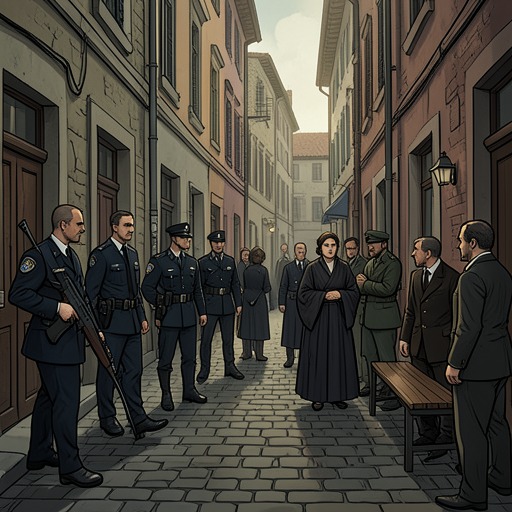
Italian Carabinieri
The Shape of WaterThe Italian Carabinieri are a national police force with a military institutional status and a chain of command separate from local police. Their appearances in the novel make that distinction practical rather than abstract: they work alongside other authorities at a heavily controlled crime scene, arrive first at a labor protest, and occupy a procedural world that does not always align neatly with the local police department. Their institutional independence is also a source of comic friction, but it carries real consequences for how policing is organized and experienced.
Organization and institutional position
A note to the novel describes the Italian Carabinieri as a national force, bureaucratically separate from local police and formally part of the military. Their separation extends to forensic work: the local police use the laboratory attached to the provincial center’s police department, while the Carabinieri have their own crime laboratories. The two forces therefore operate within distinct administrative and investigative systems, even when their responsibilities bring them to the same places.
The note adds that Carabinieri officers are often assigned to regions where they are not native. Combined with their procedural separation from local police, this geographic distance can create confusion in the execution of their duties. The account also identifies a familiar public stereotype of the Carabinieri as less than sharp-witted, a comic assumption that shadows their dealings with Inspector Salvo Montalbano. The institutional joke does not erase the force’s authority: the Carabinieri remain a national body with military status, distinct procedures, and a presence capable of shaping events on the ground.
Presence at San Giusippuzzu
The force’s most extensive visible deployment comes on the road to San Giusippuzzu. Salvo Montalbano is stopped first by an army patrol and then by a Carabinieri patrol; later, barricades and checkpoints make the journey so slow that he takes forty-five minutes to travel less than three miles. At the scene, the Colonel of the Carabinieri is present alongside the commissioner and the full Montelusa police department. The gathering places separate authorities in a single space, while the roadblocks show how their combined security presence can obstruct movement well beyond the immediate scene.
This episode establishes the Carabinieri as more than a punch line or distant bureaucracy. Their patrols control access, and their senior officer joins the wider law-enforcement response. At the same time, the scene does not describe a merger of forces: the local police and Carabinieri remain distinguishable participants within the same operation.
Labor protest and Montalbano’s response
The Carabinieri are already at the train station when workers from the salt factory occupy it after being dismissed under the euphemism that they had been made mobile. The workers’ wives lie on the tracks to prevent trains from passing. When Fazio asks whether the local police should go down to assist, Salvo Montalbano asks whom they would be helping. Fazio identifies the Carabinieri as the forces of order, and Montalbano instead directs him toward helping the people occupying the station.
The exchange reveals a divide between institutional cooperation and Montalbano’s immediate judgment about whose situation deserves assistance. The Carabinieri are not accused of misconduct; their presence simply represents the official response that the local police might be expected to support. Montalbano’s instruction reverses that expectation, giving the scene its dry political edge and aligning his practical sympathy with the dismissed workers and their families.
Narrative significance
Across these episodes, the Italian Carabinieri embody a parallel structure of policing: nationally organized, militarily situated, and procedurally distinct from local police. At San Giusippuzzu, that structure is visible in patrols, checkpoints, and the presence of a colonel alongside local officials. At the station, it becomes the point against which Montalbano’s choice is measured. The force thus helps the novel show law enforcement as a network of institutions whose jurisdictions overlap without becoming identical—and whose formal duties do not settle the question of whom a police officer should help.